
High Dynamic Range (HDR) video represents a significant leap forward in visual fidelity, offering a vastly expanded range of luminance, color, and contrast compared to Standard Dynamic Range (SDR). In many ways, HDR represents as large a visual improvement as the transition from Standard Definition to High Definition video.
While relatively few display devices and live production workflows fully operate in HDR today, adoption continues to increase across broadcast, live events, houses of worship, and sports environments. Renewed Vision is proud to be at the forefront of this transition as HDR workflows become more common in modern production systems.
This article provides a deeper technical overview of HDR technology, how it functions in live production environments, and how ProPresenter integrates into HDR signal chains.
The Evolution and Resurgence of HDR Video in Live Productions
The concept of High Dynamic Range is not new. Photography has used techniques to extend dynamic range for decades. Modern smartphones, for example, capture multiple images at different exposure or ISO levels and combine them algorithmically to preserve both highlight and shadow detail.
Video systems achieve similar results using several approaches:
- Increased sensor dynamic range
- Dual-gain sensor designs
- Computational image processing
- Expanded encoding precision
Early HDR video workflows relied heavily on post-production. Footage captured in log or RAW formats required extensive grading in applications such as DaVinci Resolve or Adobe Premiere to map captured information into delivery formats like HDR10 or Dolby Vision. These workflows demanded powerful hardware and significant processing time. Today’s adoption of HDR is driven by several converging advancements.
Advancements in Display Technology
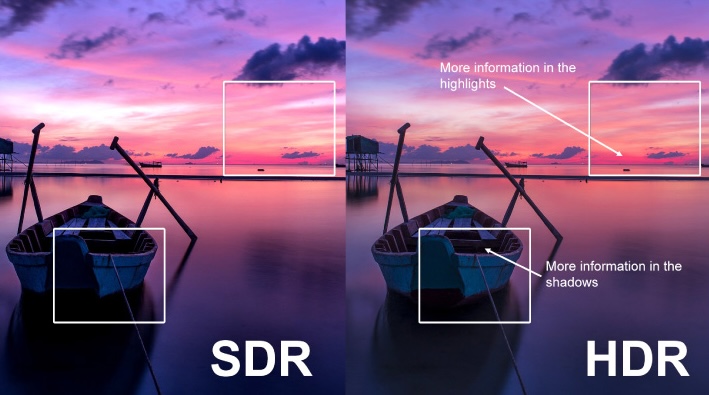
Modern televisions, LED processors, and professional monitors now achieve dramatically higher brightness levels alongside deeper blacks, especially with LED and OLED technologies. These improvements allow captured HDR information to be accurately reproduced rather than compressed into SDR limitations.
The visual difference between SDR and HDR is immediately noticeable, particularly in highlight retention and shadow detail.
Improved Camera Technology
Modern cinema and broadcast cameras capture significantly wider dynamic ranges than earlier systems. This expanded capture capability provides the foundational data required for HDR workflows.
Growth of Computer-Generated Content
Computer-generated imagery inherently operates in high dynamic range environments. HDR pipelines allow CGI elements to retain their native lighting realism when integrated with live-action footage.
Together, these developments have enabled HDR to move from cinematic post-production into real-time live environments.
How HDR Video Works: Not Just Color, But Light
HDR expands video capability by increasing both luminance range and color precision. Traditional SDR systems typically target brightness levels around 100 nits. HDR systems routinely reach peak brightness levels of 1,000 nits or higher while simultaneously preserving deep shadow detail. This expanded range produces images that more closely resemble real-world lighting conditions.
A key component enabling HDR performance is increased color precision. Rather than the 8-bit color depth commonly used in SDR workflows, HDR typically operates using 10-bit or 12-bit processing. This allows significantly more tonal steps between colors and brightness values.
If you want a deeper technical explanation of how bit depth and color channels enable HDR precision, see our companion article: Color Depth and Channels Explained.
Greater precision per pixel reduces banding, improves gradients, and allows subtle lighting transitions to remain intact throughout the signal chain.
Applications for Live Production Environments
HDR introduces meaningful advantages across live production workflows.
Enhanced Realism
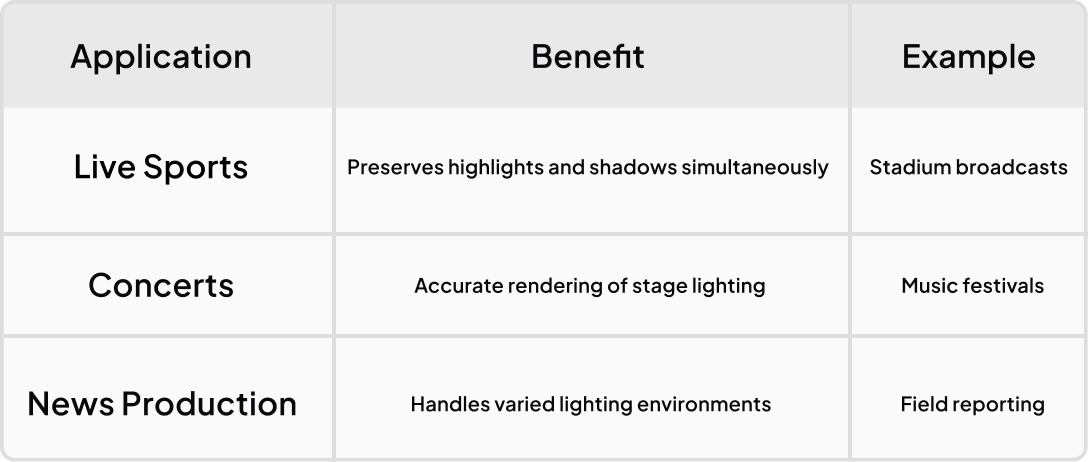
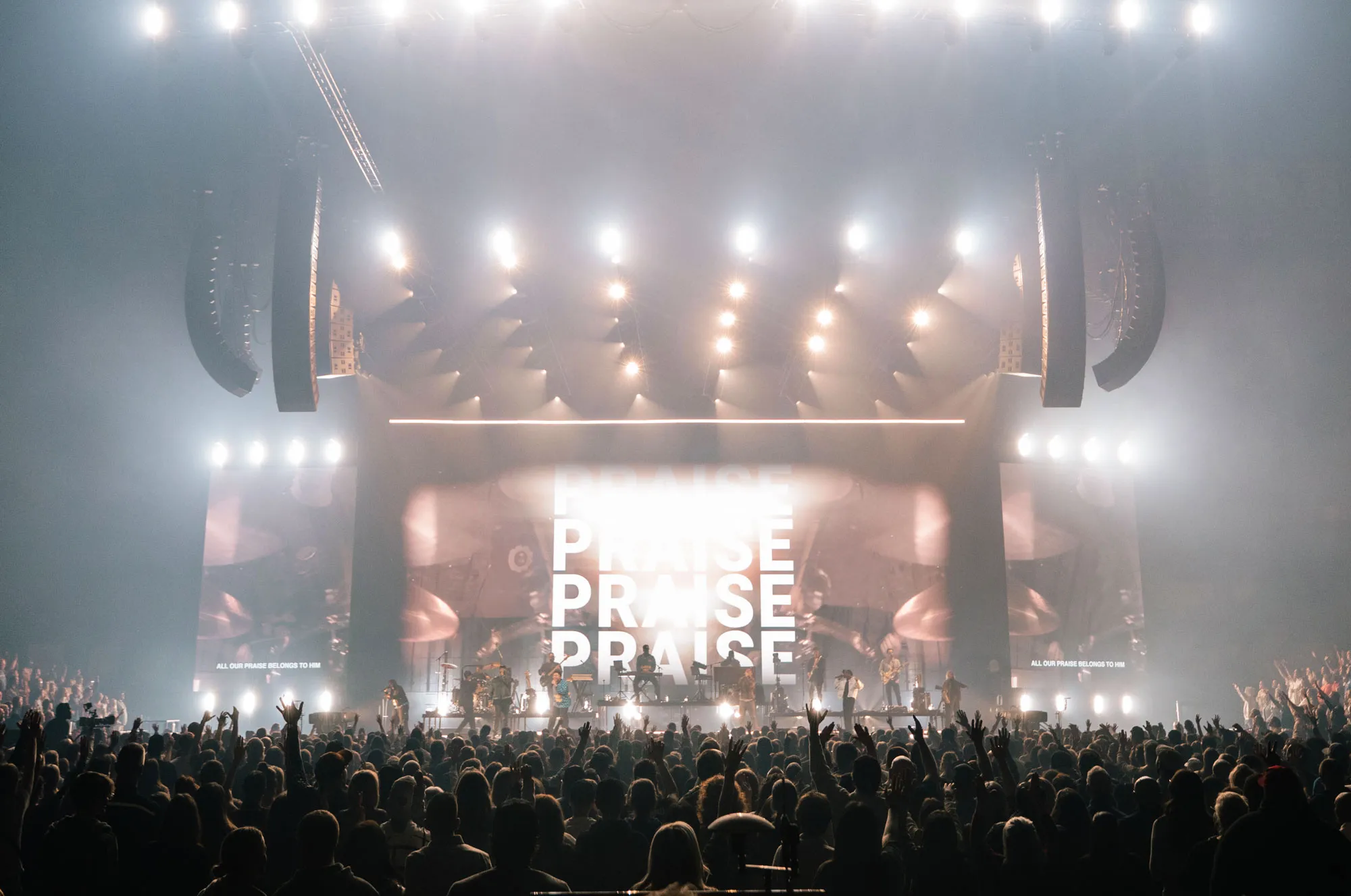
Live sports and stage productions frequently contain extreme lighting contrasts. HDR preserves detail in bright lighting elements while maintaining visibility in darker regions. Bright stage lights or sunlit outdoor events can be captured without clipping highlights, while details in shadowy areas remain visible.
Improved Color Accuracy
Events where color fidelity matters, such as product launches or theatrical productions, benefit from HDR’s expanded color representation. HDR ensures those colors are displayed with breathtaking accuracy and vibrancy.
Future-Proofing Content
Producing content in HDR ensures long-term compatibility as HDR displays become increasingly standard.
Increased Creative Freedom
Directors and cinematographers gain a larger canvas to work with, allowing for more nuanced lighting and artistic expression without technical limitations.
Types of HDR Standards
HDR formats combine multiple characteristics including transfer functions, color gamut, and metadata handling.
- HDR10 (mostly post-produced content): An open standard primarily used for post-produced content. HDR10 uses static metadata that defines brightness characteristics for an entire program. HDR10 is getting increased use in some streaming protocols like SRT and HLS.
- HDR10+ (mostly post-produced content): An evolution of HDR10 that introduces dynamic metadata, allowing brightness adjustments scene by scene.
- Dolby Vision (mostly post-produced content): A proprietary HDR format supporting advanced dynamic metadata and higher processing precision tailored to individual displays.
- Hybrid Log-Gamma (HLG) (both live and post-produced content): HLG is particularly important for live production workflows. Designed for broadcast environments, it allows HDR and SDR compatibility within a single signal and does not require metadata management. Because of this compatibility, HLG is widely adopted for live sports, events, and broadcast production.
Connection Standards for HDR Compatibility
Reliable HDR workflows depend heavily on transport infrastructure.
HDMI: The most common interface for consumer electronics. For HDR, HDMI 2.0a/b and especially HDMI 2.1 are essential. HDMI 2.1 supports higher resolutions (up to 10K), higher frame rates (up to 120Hz for 4K), and features like Enhanced Audio Return Channel (eARC) and Variable Refresh Rate (VRR), all crucial for high-quality HDR transmission.
SDI: The professional standard for broadcast and production elements. For HDR, professional SDI interfaces often utilize 12G-SDI for single-cable transmission of 4K HDR signals.
DisplayPort: Primarily used in computer monitors and graphics cards. DisplayPort 1.4 and newer versions support HDR, offering high bandwidth for high-resolution and high-refresh-rate displays.
IP Video Networks: The industry is increasingly moving towards IP-based workflows (e.g., SMPTE ST 2110). These networks can carry uncompressed or minimally compressed HDR video, offering flexibility and scalability for complex live productions.
HDR Support in ProPresenter
ProPresenter supports:
- HDR (2020PQ)
- HDR (2020HLG)
- SDR Rec.709
This means ProPresenter outputs the Rec.2020 color gamut using either PQ or HLG transfer functions depending on workflow requirements.
Most live HDR environments favor HLG due to backward compatibility with SDR infrastructure, simplifying deployment without requiring extensive downstream upgrades.
Always confirm output requirements with downstream equipment manufacturers when configuring HDR outputs.
Troubleshooting HDR Workflows
HDR introduces additional complexity because signal encoding standards and display expectations must align throughout the entire signal path.
Mismatches commonly produce unexpected visual results.
Clipped Highlights or Lost Shadow Detail: This is likely because of a mismatch between the Electro-Optical Transfer Function the display is expecting and the Opto Electro Transfer Function the source is sending. For example, if ProPresenter is sending an HLG signal but the display is set to expect a PQ signal, you would see this problem.
Oversaturated Colors, Hue Shifts, Gamut Clipping, Color Bleeding or Banding: This is likely caused because of Color Space incompatibilities. For example, if you are sending an HDR signal but are displaying on a Rec.709 (SDR) display, you will often have these anomalies. Ensure the signal that is being sent matches with the entirety of the signal flow.
Flat or Overexposed Images: This is most often caused by incorrect peak luminance metadata. For example, your display is set for ST2084 300 (at a 300 nits max) and you are feeding it a ST2084 10000 signal. This would cause a lot of the image to look overexposed. If you did the inverse then it would look very flat.
Successful HDR deployment requires consistency across processing, transmission, and display stages.
Final thoughts on HDR:
HDR is about delivering:
- More realistic images
- Better detail in challenging lighting
- A more immersive experience for your audience
While it does add some complexity, the payoff when everything is aligned is absolutely worth it. If you want to include navigating HDR in your live production workflow, we’re making sure ProPresenter is ready and built with the future in mind.



Stay Updated with Our Newsletter
Get the latest news, updates, and exclusive offers delivered straight to your inbox.
Dúvidas?
Consulte as nossas Perguntas Frequentes ou a nossa Base de Conhecimento, criadas para responder às suas perguntas. Precisa de ajuda adicional? Fale com um agente da equipa de suporte!
Is this a web or browser version of ProPresenter?
No. You keep using the ProPresenter desktop app. Cloud keeps your machines in sync — there's no presenting from a browser.
Does clicking a slide on one device change what's on screen somewhere else?
No. Editing on one device is completely independent from what's live on another. You can edit freely mid-service without affecting the output.
Is my show file safe?
Yes — your whole workspace is backed up and can be downloaded to any machine, any time.
Can multiple campuses share one workspace?
Cloud keeps your machines in sync today; richer multi-site and team-collaboration workflows are on the way.